
The opposite of synonyms and antonyms is not simply one single word. It refers to a different type of lexical relationship where words are connected by meaning, usage, or association without being exact synonyms or direct opposites.
Understanding these relationships helps writers choose more accurate vocabulary, improve communication, and express ideas with greater precision.
While synonyms describe words with similar meanings and antonyms describe words with opposite meanings, other word relationships include related words, homonyms, hypernyms, hyponyms, collocations, and semantic associations.
These connections form the structure of the English language and allow speakers and writers to select the most natural word for every situation.
Understanding Synonyms, Antonyms, and Other Word Relationships

Words do not exist independently. They form networks of meaning called lexical fields or semantic networks.
1. Synonyms: Words With Similar Meanings
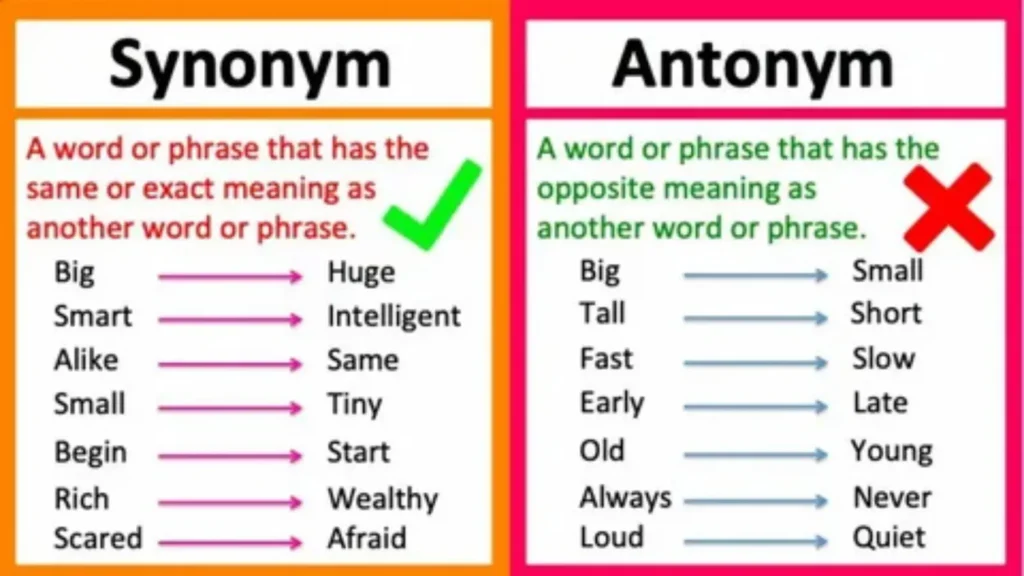
Synonyms are words that share similar meanings but often differ in tone, intensity, or context.
Examples:
| Word | Synonym | Difference |
| Happy | Joyful | Stronger emotional happiness |
| Beautiful | Attractive | More general appeal |
| Strong | Powerful | Suggests greater influence or force |
| Grateful | Thankful | Similar, but grateful often feels deeper |
A common mistake is assuming synonyms are interchangeable. They are usually similar, not identical.
For example:
- “She is slim” sounds positive.
- “She is skinny” may sound negative.
Both relate to body size, but the emotional tone changes.
2. Antonyms: Words With Opposite Meanings
Antonyms represent contrast.
Examples:
- hot ↔ cold
- strong ↔ weak
- beautiful ↔ ugly
- success ↔ failure
Antonyms are useful because they create comparison, emphasis, and clarity.
Example:
“Great leaders understand both success and failure.”
The contrast creates a stronger message.
The Real Opposite of Synonyms and Antonyms: Semantic Distance
A useful way to understand vocabulary is through a semantic distance model.
The Vocabulary Relationship Spectrum
Exact Similarity
↓
Synonyms
↓
Related Concepts
↓
Associated Ideas
↓
Unrelated Words
↓
Opposite Meaning
↓
Antonyms
This model shows that words exist on a relationship scale rather than in isolated categories.
For example:
Word: Amazing
Synonyms
- incredible
- remarkable
- extraordinary
Related words
- impressive
- memorable
- inspiring
Associated concepts
- achievement
- success
- excellence
Antonyms
- ordinary
- disappointing
- unimpressive
Why Learning Synonyms and Word Relationships Matters
Strong vocabulary is not about using complicated words. It is about choosing the most accurate word.
Benefits of Understanding Word Relationships
1. Better Writing Precision
Compare:
“She gave a good presentation.”
vs.
“She delivered an impressive presentation.”
The second sentence communicates a clearer emotional response.
2. Stronger Professional Communication
Business writing requires careful word selection.
Compare:
“We need a new plan.”
vs.
“We need an innovative strategy.”
The second version creates a more professional impression.
3. Improved Emotional Expression
Different words carry different emotional weight.
Example:
“I am grateful.”
“I am deeply appreciative.”
“I am profoundly thankful.”
Each expresses gratitude at a different intensity level.
Synonym Hierarchy: Choosing Words by Strength
One powerful vocabulary framework is the emotional intensity ladder.
Example: Synonyms for Happy
| Level | Word | Meaning |
| Basic | Happy | General positive feeling |
| Moderate | Cheerful | Consistently positive mood |
| Strong | Joyful | Deep happiness |
| Very Strong | Thrilled | Excited happiness |
| Extreme | Ecstatic | Overwhelming happiness |
Choosing the right level prevents exaggerated writing.
For example:
“The customer was ecstatic about the service.”
works for an extraordinary experience.
“The customer was ecstatic about receiving an email.”
may sound unnatural.
Context Selection Matrix: Choosing the Right Synonym

The best synonym depends on audience, purpose, and tone.
| Situation | Better Choice |
| Casual conversation | common everyday words |
| Academic writing | precise formal vocabulary |
| Marketing | emotional persuasive words |
| Business communication | professional and confident words |
| Creative writing | vivid descriptive words |
| Customer service | warm and empathetic words |
Examples of Semantic Word Groups
Synonyms for Grateful
Thankful
Meaning: Feeling appreciation for something received.
Tone: Warm and common.
Formality: Neutral.
Best contexts:
- conversations
- emails
- personal messages
Common collocations:
- thankful for your help
- thankful to my family
Example:
“Thank you. I am thankful for your support.”
Appreciative
Meaning: Recognizing the value of something.
Tone: Professional and respectful.
Formality: Slightly formal.
Best for:
- workplace communication
- customer relationships
Example:
“We are appreciative of your continued partnership.”
Indebted
Meaning: Feeling that someone has provided significant help.
Tone: Deep gratitude.
Formality: Formal.
Example:
“I am forever indebted to those who supported my journey.”
Synonyms for Beautiful
Attractive
Meaning: Pleasing in appearance or quality.
Tone: General and practical.
Common uses:
- attractive design
- attractive features
Example:
“The website has an attractive layout.”
Stunning
Meaning: Extremely impressive or beautiful.
Tone: Strong admiration.
Example:
“The photographer captured a stunning landscape.”
Elegant
Meaning: Beautiful because of simplicity, style, or refinement.
Best contexts:
- fashion
- design
- professional descriptions
Example:
“She chose an elegant solution to the problem.”
Synonyms for Strong
Powerful
Meaning: Having great force, influence, or ability.
Common collocations:
- powerful message
- powerful leader
Example:
“The speaker delivered a powerful argument.”
Resilient
Meaning: Able to recover from difficulty.
Best contexts:
- leadership
- personal development
- psychology
Example:
“Successful teams are resilient during challenges.”
Robust
Meaning: Strong, reliable, and able to handle pressure.
Common contexts:
- technology
- systems
- business
Example:
“The company developed a robust strategy.”
Synonyms vs Related Words: The Important Difference
Many learners confuse synonyms with related words.
Example:
Word: “Teacher”
Synonyms:
- instructor
- educator
- tutor
Related words:
- classroom
- student
- lesson
- school
A student is related to a teacher but is not a synonym.
Common Vocabulary Mistakes
Mistake 1: Using a Synonym Without Checking Tone
Incorrect:
“Your mistake was hilarious.”
The word “hilarious” means extremely funny and may sound insulting.
Better:
“Your mistake was understandable.”
Mistake 2: Choosing Complex Words to Sound Intelligent
Advanced vocabulary does not always improve writing.
Simple:
“We need to solve this problem.”
Better than:
“We need to facilitate a resolution regarding this complication.”
Clear writing is usually stronger writing.
Mistake 3: Ignoring Collocations
Words naturally appear with certain partners.
Correct:
- make a decision
- strong argument
- deep appreciation
Incorrect:
- do a decision
- powerful appreciation
How Writers Can Build Better Vocabulary
1. Learn Words in Groups
Do not memorize:
“Beautiful = pretty”
Instead learn:
Beautiful:
- elegant
- stunning
- attractive
- breathtaking
- charming
with their differences.
2. Study Real Examples
Context teaches meaning better than definitions alone.
3. Build Semantic Maps
Connect words by:
- meaning
- emotion
- intensity
- formality
- situation
This creates a stronger mental vocabulary network.
FAQ: Opposite of Synonyms and Antonyms
What is the opposite of a synonym?
The opposite of a synonym is generally an antonym, but words can also be unrelated or connected through other semantic relationships.
Are all non-synonyms antonyms?
No. Most words are neither synonyms nor antonyms. They may simply have different meanings.
Example:
“Dog” and “book” are neither synonyms nor antonyms.
What are related words?
Related words share a connection but do not have the same meaning.
Example:
“Hospital,” “doctor,” and “medicine” are related words.
Why are synonyms important in writing?
Synonyms improve clarity, prevent repetition, and allow writers to express precise emotions and ideas.
How do I choose the best synonym?
Consider:
- Meaning
- Audience
- Formality
- Emotional intensity
- Common usage
Final Takeaway
The opposite of synonyms and antonyms is not simply another category of words. It represents the broader world of lexical relationships that shape how language works.
Great vocabulary comes from understanding connections between words: similarities, differences, associations, intensity levels, and contexts. Instead of searching for a replacement word, skilled writers choose the word that communicates the exact meaning, emotion, and purpose they intend.
Mastering these relationships transforms vocabulary from a collection of words into a powerful communication system.

Mark Twain ka asal naam Samuel Clemens tha. Yeh apni humorous aur realistic writing ke liye mashhoor hain. Unki famous books mein The Adventures of Tom Sawyer aur Adventures of Huckleberry Finn shamil hain. Unhone American society ko bohat achi tarah depict kiya.