
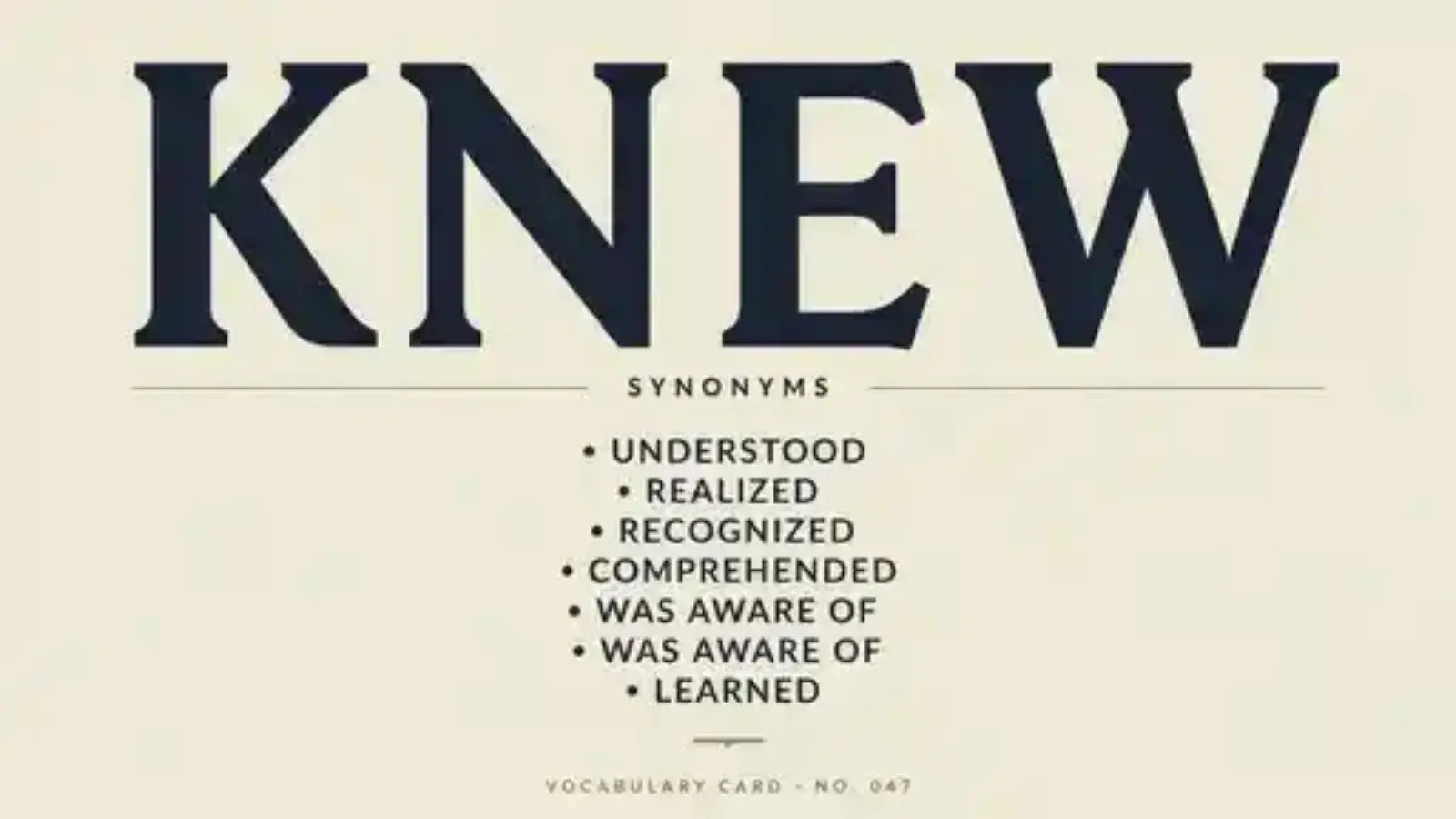
Looking for strong alternatives to the word “knew”? Whether you’re writing an essay, polishing professional communication, or simply wanting more precise everyday language, the right synonym can make your sentences clearer and more engaging.
This guide gives you practical replacements for “knew,” explains subtle differences in meaning and tone, and shows exactly when to use each one.
Quick answer: Common synonyms for “knew” include understood, realized, recognized, was aware of, grasped, comprehended, perceived, learned, and discovered.
The best choice depends on whether you mean factual knowledge, sudden insight, recognition of a person or fact, or deeper understanding.
“Knew” is the simple past form of the verb “know.” It expresses that someone had information, awareness, familiarity, or understanding at a point in the past.
Because it is so common, repeating “knew” can make writing feel flat. Choosing more specific synonyms adds precision, emotional color, and stylistic variety.
Why Synonyms for “Knew” Matter

Using only “knew” limits how accurately you can describe a situation. Did the person simply have the information, or did they suddenly understand something important? Were they familiar with a face, or did they fully grasp a complex idea? Strong synonym choice:
- Improves clarity and nuance
- Matches the right tone (casual, formal, literary, professional)
- Strengthens credibility and readability
An Original Framework: The Knowledge Precision Ladder

To choose the best synonym, use this simple Knowledge Precision Ladder. It ranks alternatives by how specific and deep the knowledge is:
- Basic awareness – simple possession of information
- Recognition – identifying something or someone
- Realization – sudden or gradual insight
- Understanding / Comprehension – deeper grasp of meaning or implications
- Familiarity / Experience – knowledge gained through personal contact or practice
Climb the ladder according to the exact meaning you want to convey. This framework adds genuine information gain beyond a plain list of words.
Semantic Clusters of Synonyms for “Knew”

Everyday Conversation
These feel natural in spoken English and informal writing.
- Understood – Grasped the meaning or situation. Tone: Neutral to warm. Formality: Everyday to semi-formal. Example: “I finally understood why she left early.” Collocations: fully understood, never understood, understood the point.
- Realized – Suddenly became aware of something. Tone: Often carries a sense of discovery or mild surprise. Example: “He realized he had left his keys at home.”
- Figured out – Worked something out through thinking. Tone: Casual and problem-solving. Example: “She figured out the password after three tries.”
Professional & Business Communication
Prefer clear, confident language.
- Was aware of – Had knowledge of a fact or situation. Tone: Neutral and objective. Best contexts: Reports, emails, meeting notes. Example: “The team was aware of the deadline change.”
- Recognized – Identified or acknowledged something. Example: “Management recognized the need for better training.”
- Acknowledged – Accepted or admitted knowledge of something (sometimes publicly). Example: “She acknowledged the risks before approving the plan.”
Academic & Formal Writing
These signal precision and intellectual engagement.
- Comprehended – Fully understood something complex. Tone: Formal and thorough. Example: “Few readers fully comprehended the implications of the theory.”
- Perceived – Became aware through the senses or intellect. Example: “The researcher perceived a pattern in the data.”
- Apprehended – Grasped or understood (more formal/literary). Note: Can also mean “arrested,” so context matters.
Emotional Expression & Creative Writing
These carry feeling or narrative energy.
- Sensed – Felt or intuited something without hard evidence. Example: “She sensed that something was wrong.”
- Discovered – Found out something previously unknown. Example: “He discovered the truth only after the meeting.”
- Learned – Gained knowledge (often through experience or study). Example: “They learned the hard way that the market was shifting.”
Literary & Elevated Style
- Knew full well (idiomatic intensification)
- Was cognizant of (very formal)
- Discerned – Detected or distinguished something subtle.
Key Comparisons: “Knew” vs Related Words

Knew vs Understood “Knew” can mean simple possession of a fact. “Understood” implies grasping meaning or implications.
- Use knew for information: “I knew her name.”
- Use understood for comprehension: “I understood her reasons.”
Knew vs Realized “Realized” usually suggests a moment of insight. “Knew” can be ongoing or long-standing knowledge.
- “I knew the answer all along” vs “I suddenly realized the answer.”
Knew vs Recognized “Recognized” focuses on identification (a face, a pattern, a fact). “Knew” is broader.
- “I recognized her from the conference” is more precise than “I knew her.”
Knew vs Was Aware Of “Was aware of” often sounds more formal or cautious and works well when you want to avoid claiming deep understanding.
Practical Decision Guide
Ask yourself:
- Is the knowledge sudden? → realized, discovered
- Is it about identifying someone or something? → recognized
- Is it deeper comprehension? → understood, comprehended, grasped
- Is the tone formal/professional? → was aware of, acknowledged, perceived
- Is the tone casual? → figured out, knew, got
Antonyms and Opposite Ideas
Useful opposites include: did not know, was unaware, was ignorant of, failed to realize, overlooked, missed, was oblivious to.
Common Mistakes and Writing Tips
- Overusing “knew” creates monotony. Vary it according to the Knowledge Precision Ladder.
- Avoid “knew of” when you mean deep understanding; “knew about” or “was aware of” is often clearer.
- In past narratives, pair the synonym with time markers for smoothness: “By then she had realized…”
- For AI search and voice queries, clear example sentences and comparison sections help systems extract accurate answers.
FAQ: Synonyms for Knew
What is the best synonym for “knew”? There is no single best option. Understood and realized are the most versatile for everyday and professional use.
Is “knew” formal or informal? It is neutral and works in almost any register. More formal alternatives include was aware of, comprehended, and perceived.
Can I use “knew” in academic writing? Yes, but stronger precision often comes from understood, recognized, or was cognizant of.
What are some idiomatic expressions related to “knew”? “Knew full well,” “knew better,” “knew by heart,” “as far as I knew.”
How do I choose the right synonym for marketing or persuasive writing? Prefer words that create insight or discovery (realized, discovered) to engage the reader emotionally.
Mastering synonyms for “knew” is less about collecting a long list and more about matching the exact shade of knowledge, tone, and context you need.
Use the Knowledge Precision Ladder, study the clusters above, and test alternatives in your own sentences. Over time, your writing will become clearer, more precise, and more engaging whether you are drafting an email, crafting a story, or building authoritative content.

Mark Twain ka asal naam Samuel Clemens tha. Yeh apni humorous aur realistic writing ke liye mashhoor hain. Unki famous books mein The Adventures of Tom Sawyer aur Adventures of Huckleberry Finn shamil hain. Unhone American society ko bohat achi tarah depict kiya.