
Avoidant describes a tendency to withdraw from emotional closeness, social interaction, or confrontation to protect oneself.
Top synonyms include aloof, detached, withdrawn, reserved, distant, standoffish, reclusive, and evasive. Choose based on context: “detached” for emotional neutrality, “reclusive” for physical isolation, or “evasive” for dodging specifics.
In psychology, it often links to avoidant attachment or avoidant personality traits.
People searching for “avoidant synonym” typically want richer ways to describe self-protective distance—whether in relationships, writing, therapy discussions, or everyday observations.
This guide delivers far more than a list: a complete lexical resource with semantic depth, practical frameworks, and nuanced guidance.
What Does “Avoidant” Really Mean?
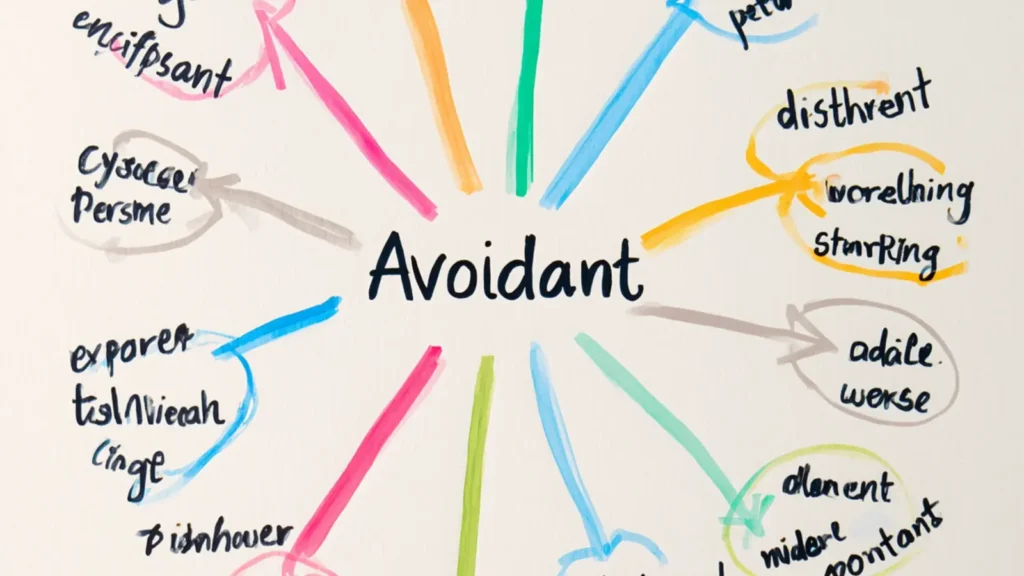
“Avoidant” is an adjective referring to behavior or personality traits characterized by a deliberate or instinctive turning away from people, emotions, situations, or responsibilities that feel threatening, overwhelming, or draining. It stems from the verb “avoid” and implies a pattern of evasion or withdrawal rather than outright rejection.
In everyday language: An avoidant colleague might skip team social events. In psychology, avoidant attachment involves discomfort with intimacy and a strong emphasis on independence. Avoidant Personality Disorder (AvPD) features intense social inhibition and fear of rejection.
Learning synonyms for “avoidant” sharpens expression, reduces repetition, and builds emotional intelligence. Precise word choice conveys subtle shades of meaning—helping writers, therapists, leaders, and learners communicate with greater empathy and accuracy.
Why Synonyms Matter in 2026: Semantic SEO, Communication, and Personal Growth
In an era of AI search and voice queries, rich lexical resources rank higher because they satisfy complex intent. More importantly, expanding your avoidance-related vocabulary improves self-awareness, conflict resolution, and relationship dynamics. Misusing words like “aloof” (which can imply superiority) versus “withdrawn” (suggesting retreat) can alter perceptions dramatically.
Original Framework: The Avoidance Lexicon Matrix This practical tool categorizes synonyms across four dimensions for informed choices:
- Emotional Intensity: Mild (reserved) to Strong (reclusive).
- Formality Spectrum: Casual to Academic/Clinical.
- Context Cluster: Social, Professional, Psychological, Literary.
- Connotation Balance: Neutral, Negative, or Empathetic.
Use this matrix as a decision tree: Match your audience, tone, and goal to select the optimal word.
Semantic Clusters: Synonyms Organized by Context
1. Everyday Conversation & Informal Language
These words feel natural in casual talk:
- Distant: Implies emotional or physical space. Tone: Neutral to slightly negative. Example: “He’s been distant since the argument.” Collocations: grow distant, keep someone at a distance.
- Stand-offish (or standoffish): Suggests unfriendliness or reluctance to engage. Best for describing initial impressions.
- Withdrawn: Focuses on pulling back, often temporarily. Grammar note: Often used as “become withdrawn.”
2. Professional & Business Communication
- Reserved: Professional and polished; implies restraint rather than flaw. Comparison: Reserved vs. Avoidant — “Reserved” sounds like a strength (thoughtful), while “avoidant” may imply a problem.
- Detached: Emphasizes objectivity or emotional separation. Ideal for leadership or analytical roles. Example: “Her detached approach helped during the crisis.”
- Unapproachable: Highlights barriers to interaction. Useful in performance reviews.
3. Psychological & Clinical Contexts
- Dismissive (often paired as dismissive-avoidant): Common in attachment theory; downplays emotional needs.
- Evasive: Focuses on dodging direct answers or commitment.
- Antisocial (use cautiously): Can overlap but risks clinical misunderstanding (not the same as asocial).
4. Creative Writing, Literary & Persuasive English
- Aloof: Classic literary term suggesting cool superiority or mystery. Example: “The aloof protagonist observed the world from afar.”
- Reclusive: Strong isolation imagery, often positive for artists or negative for hermits.
- Uncommunicative: Emphasizes lack of sharing.
Other strong options: remote, unsociable, unforthcoming, reticent, introverted (when avoidance stems from preference rather than fear), shy (milder, fear-based).
Detailed Synonym Profiles
Aloof Definition: Coolly distant or uninterested. Tone: Often superior or mysterious. Formality: Medium to high. Best contexts: Literature, character descriptions. Vs. Avoidant: Aloof implies choice or temperament; avoidant suggests deeper pattern or fear. Example: “His aloof demeanor masked inner vulnerability.”
Detached Definition: Emotionally or objectively separated. Usage notes: Positive in medicine/therapy (“detached concern”); negative in relationships. Collocations: emotionally detached, remain detached.
Withdrawn Definition: Retreated socially or emotionally. Grammar: Frequently passive (“She seemed withdrawn”). Common mistake: Confusing with “introverted” — introversion is energy preference; withdrawal is often reactive.
Avoidant vs. Related Words: Nuanced Comparisons
- Avoidant vs. Evasive: Avoidant is broader (lifestyle pattern); evasive targets specific dodging (e.g., questions).
- Avoidant vs. Reserved: Reserved is socially acceptable restraint; avoidant may signal dysfunction.
- Avoidant vs. Reclusive: Reclusive emphasizes physical solitude; avoidant focuses on emotional avoidance.
- Avoidant vs. Detached: Detached can be temporary and strategic; avoidant feels more ingrained.
Recommendation Matrix
| Situation | Best Synonym | Why? |
|---|---|---|
| Therapy discussion | Dismissive-avoidant | Clinical precision |
| Novel character | Aloof | Evocative imagery |
| Workplace feedback | Reserved | Professional tone |
| Relationship talk | Distant | Empathetic, less clinical |
| Marketing copy | Independent | Positive reframe |
Antonyms, Related Words & Lexical Field
Antonyms: Sociable, outgoing, engaging, affectionate, approachable, connected, warm, open, gregarious. Related concepts: Avoidance coping, social inhibition, emotional unavailability, self-reliance, independence. Idioms & Phrases: Keep at arm’s length, hold back, steer clear of, walls up, emotionally unavailable. Collocations: Avoidant behavior, avoidant attachment, avoidant personality.
Pronunciation & Common Mistakes
- Avoidant: /əˈvɔɪ.dənt/ (uh-VOY-dunt). Mistakes: Overusing “avoidant” in non-clinical writing (sounds technical); applying psychological labels casually without context.
Actionable Writing & Communication Tips
- Audience adaptation: Use softer terms (“private,” “independent”) for general audiences; precise clinical language for professionals.
- Tone balance: Pair with empathy: “Her avoidant tendencies stem from past experiences…”
- Vocabulary ladder: Basic → distant; Intermediate → reserved; Advanced → aloof/reclusive; Expert → dismissive-avoidant.
- Editing tip: Search your draft for repeated “avoidant” and rotate 2-3 strong synonyms.
- For learners: Practice with sentence transformations to internalize nuances.
FAQ Section
What is the best synonym for avoidant in formal writing? Reserved or detached, depending on emphasis.
Is “avoidant” negative? It can be, but context matters self-awareness of avoidant patterns is positive growth.
How does avoidant attachment differ from avoidant personality? Attachment is relational style; personality disorder is more pervasive and impairing.
Can avoidant behavior be positive? Yes healthy boundaries and selective engagement prevent burnout.
Building Topical Authority & Lasting Value
This resource goes beyond lists by offering a usable framework, real-world examples, psychological context, and decision tools. Whether you’re a writer seeking lexical precision, a professional improving feedback, or someone reflecting on relationships, these distinctions empower better choices.

Stephen King horror aur thriller novels ke king kehlate hain. Unki famous books mein It, The Shining, aur Carrie shamil hain. Unki kahaniyon par kai movies bhi bani hain.